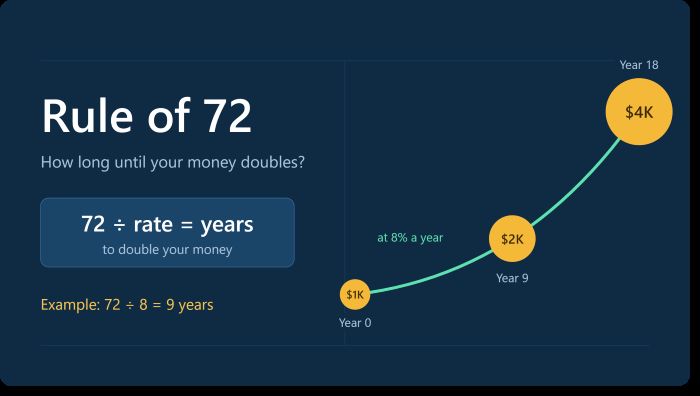
How long will it take for your money to double? You don’t need a spreadsheet to get a good answer. The Rule of 72 is a mental shortcut that turns any annual growth rate into an approximate doubling time in a few seconds. It works for savings, investments, inflation and even debt.
What is the Rule of 72?
Divide 72 by the annual rate of return (as a whole number). The result is roughly how many years it takes for money to double.
Years to double ≈ 72 ÷ annual interest rate
| Annual rate | Years to double (Rule of 72) |
|---|---|
| 4% | 18 years |
| 6% | 12 years |
| 8% | 9 years |
| 10% | 7.2 years |
| 12% | 6 years |
At 8% a year, for example, 72 ÷ 8 = 9 years. The precise answer using compound interest is about 9.0 years, so the shortcut is remarkably close.
Why does it work?
The rule is a simplification of the compound interest formula. Because returns are added to your balance and then earn returns themselves, growth speeds up over time. The number 72 happens to give accurate doubling times for the range of rates most savers and investors deal with, roughly 6% to 10%, and it divides neatly by many numbers.
For very low rates, some people use 70 or 69 instead, which is slightly more precise. For quick everyday estimates, 72 is close enough.
4 practical ways to use the Rule of 72
1. Compare investment options
A savings account at 3.5% doubles your money in about 20 years. An investment averaging 10% could double it in about 7. Seeing the difference in years, rather than percentages, makes trade-offs clearer.
2. Understand the cost of fees
If an investment returns 9% but charges 1.5% in fees, your net return is about 7.5%. That stretches doubling time from 8 years to roughly 9.6 years. Over a lifetime, that’s one fewer doubling, which can mean a much smaller final amount.
3. See how inflation erodes savings
The rule works in reverse for inflation. At 6% inflation, prices double, and your money’s purchasing power halves, in about 12 years. Money sitting in an account earning less than inflation is quietly losing value.
4. Recognise how fast debt grows
Credit card balances can carry very high interest. At 36% a year, unpaid debt doubles in about 2 years (72 ÷ 36). That’s a powerful reason to clear high-interest debt before investing.
Doubling, then doubling again
The real magic appears when you count multiple doublings. At 9%, money doubles roughly every 8 years:
| Years | Value of 1,00,000 at ~9% |
|---|---|
| 0 | 1,00,000 |
| 8 | ~2,00,000 |
| 16 | ~4,00,000 |
| 24 | ~8,00,000 |
| 32 | ~16,00,000 |
Starting just 8 years earlier can mean one extra doubling by retirement. That’s why time is often more important than the amount you start with.
Limitations to keep in mind
- It’s an estimate. It’s most accurate for rates between about 6% and 10%.
- Returns aren’t fixed. Market investments go up and down; the rule assumes a steady average.
- It ignores taxes, fees and extra contributions unless you adjust the rate yourself.
- It only answers one question: time to double. For regular monthly savings or exact figures, use a full calculator.
For exact numbers with monthly deposits, different compounding periods and your own timeline, try BrassSmile’s compound interest calculator. Use the Rule of 72 for quick intuition, and a calculator when you’re ready to plan.
Frequently asked questions
Does the Rule of 72 work for monthly compounding?
Yes, as an approximation. Use the annual rate; the result will still be close.
Can I use it to estimate tripling?
A similar shortcut uses 114 instead of 72 for tripling time, but it’s less commonly used.
Is the Rule of 72 used by professionals?
It’s a well-known rule of thumb for quick mental checks. Detailed planning always uses exact calculations.
Final thoughts
The Rule of 72 makes compounding feel real. It shows why starting early matters, why fees and high-interest debt are so damaging, and why inflation can’t be ignored, all with one simple division.